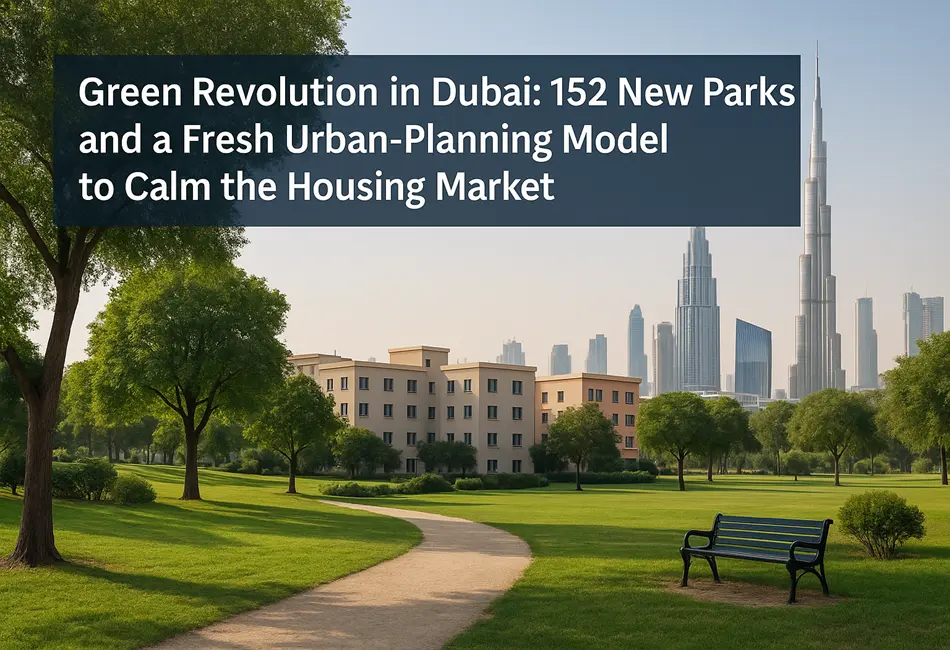

🌿 Green Revolution in Dubai:
152 New Parks and a Fresh Urban-Planning Model to Calm the Housing Market
Dubai Enters the Era of the “Smart Sustainable City”
What Policies and Programs Have Been Approved
- A new urban planning & housing policy package — along with a “Digital Resilience” framework — has been approved by Sheikh Hamdan bin Mohammed bin Rashid Al Maktoum (Crown Prince of Dubai and Chairman of Dubai’s Executive Council). (Arabian Business)
- The new framework introduces a revamped planning model for residential neighbourhoods, focusing on family-centred, mixed-use, community-oriented areas (residential + services + urban public space). (Gulf Business)
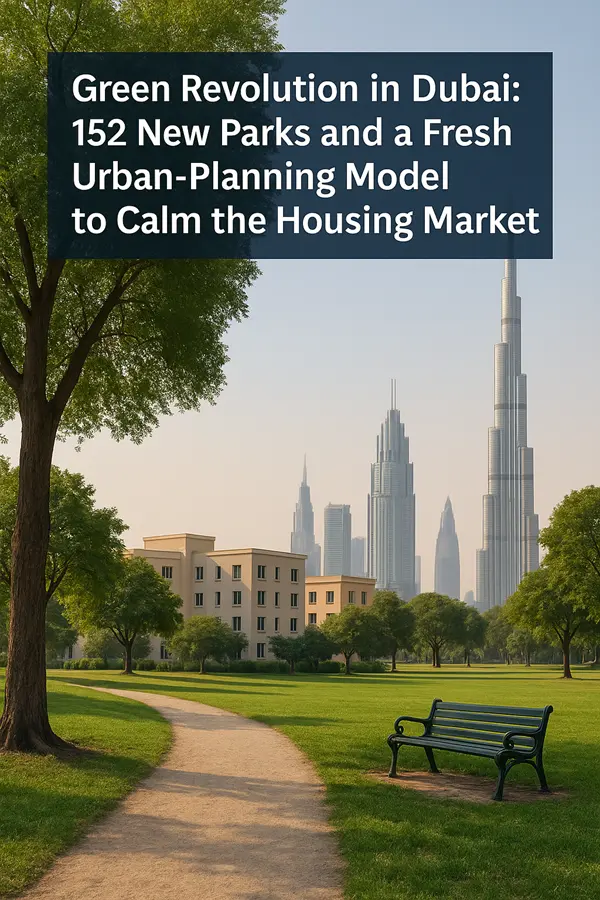
- As part of this plan, Dubai will build 152 new public parks, add over 33 km of cycling paths, and launch a city-wide digital resilience and infrastructure strategy to support smart city services. (Gulf News)
Long-Term Vision: Urban Master Plan & Real Estate Strategy
- The new planning model is aligned with the broader Dubai 2040 Urban Master Plan. It emphasises environmental sustainability, green open spaces, energy-efficient buildings, and urban design in harmony with population needs. (Gulf Business)
- In addition, the broader Dubai Plan 2033 (and related real estate strategy) aims to create high-quality sustainable communities, transparent real estate markets, and attract international investment, while strengthening social and support infrastructure. (Government of Dubai Media Office)
Green Infrastructure, Smart Buildings & Better Quality of Life
- The policies encourage construction of sustainable, energy-efficient buildings — focusing on efficient design, resource use, and environmentally friendly construction methods. (Gulf Business)
- The overall goal: combine modern urban living, high quality of life, and environmental stewardship. This covers green living, public green spaces, sustainable transport (walkways, cycling, public transit), and smart-city digital infrastructure & services. (Gulf News)
🌏 Why Dubai Is Doing This
- Population growth & migration pressure — Dubai’s expanding resident base (expats, new families, international investors) demands more housing and better infrastructure. Urban planning needs to evolve accordingly.
- Global competitiveness & quality-of-life upgrade — Dubai aims to position itself as a world-class city offering modern infrastructure, high living standards, and family-friendly communities.
- Environmental sustainability & climate considerations — Given UAE’s climate, efficient energy/water use, sustainable transport, and green spaces are essential. These policies align Dubai with global environmental goals.
- Attracting investment & stabilizing the real estate market — By improving infrastructure, creating high-quality communities, and ensuring transparent planning, Dubai seeks to attract both local and international buyers — promoting stability instead of speculative spikes.
✅ Expected Impact on Real Estate Market & Urban Life (Short- & Long-Term)
Short-Term:
- As parks, cycling paths, residential neighbourhoods, and smart-city infrastructure roll out, the supply becomes more structured and predictable.
- Market may cool down somewhat — reducing erratic price increases.
- At the same time, quality of life and public amenities will improve for residents.
Long-Term:
- Properties in well-planned, green, well-connected, amenity-rich areas will become more valuable — especially for end-users (families, residents) instead of purely speculative investors.
- For investors, risk drops because infrastructure and regulations provide a stable, dependable environment for both resale value and rental income.
- For residents, the city becomes more liveable: access to parks, green space, mobility options (walking, cycling), good services (digital infrastructure, schools, clinics), and community-oriented neighbourhoods.
💡 Conclusion: Can These Policies Balance Supply and Demand?
Yes — if they are implemented properly. The newly approved policies create a framework that can regulate supply (with better-quality construction and planning) while shifting demand toward real needs (housing, living, not speculation). If this path is followed, Dubai’s real estate market is likely to evolve toward stability, sustainability, and genuine long-term value, rather than short-term bubbles.
🔗 Sources
- “Sheikh Hamdan approves plan for 152 new parks and a citywide digital resilience framework.” Arabian Business, Dec 8, 2025. (Arabian Business)
- “Sheikh Hamdan announces 152 new Dubai parks, 33 km of cycling tracks.” Gulf News, Dec 8, 2025. (Gulf News)
- “Sheikh Hamdan approves more than 150 new parks in Dubai as part of urban planning push.” The National, Dec 8, 2025. (thenational-the-national-prod.cdn.arcpublishing.com)
- “Dubai sets new standards for urban planning and digital governance under 2033 Agenda.” Gulf Business, Dec 2025. (Gulf Business)
- “H.H. Sheikh Hamdan approves Dubai residential planning model.” Dubai Eye 103.8 report, Dec 8, 2025. (Dubai Eye 103.8)